Are you ready to really improve your voice for greater efficiency?
Click here for a free consultation
My name is Meta Powell and I am passionate about singing, singing technique and everything related to voice production; and in particular, the classically trained operatic voice. Anyone who has ever watched a TV talent show will know what an impact a great voice can have! Especially a classically trained voice.
I have been singing professionally for more than three decades, and have dedicated myself to the study of the voice in all its aspects. I’ve changed voice fach twice, moving from lyric mezzo to dramatic soprano, and along the way I have been privileged to work with some truly wonderful people in the operatic and classical music world.
The importance of good singing technique
I believe my adventurous journey as a singer serves me extremely well in my role as a teacher. I have an acute sense of perception in spotting imbalances in the voice, and with that foundation we can work together to improve the technical side of singing as a foundation for building a remarkable voice.
The singing technique I teach is deeply rooted in the principles of traditional Bel Canto—the foundation of all great singing. However, rather than relying solely on historical guesswork, I integrate a modern, holistic approach that is supported by vocal science. This combination allows us to take direct action to build your vocal stability and correct imbalances immediately. No more guessing or relying only on vague sensations. By removing the uncertainty from the process, this method empowers anyone to transform their singing with clarity and confidence.
I like to tell my clients that singing isn’t rocket science, and a beautiful singing voice isn’t necessarily something we are “gifted”, it’s a matter of finding the right functions, and then making sure that all of these functions are present when we sing, You will soon become you own teacher, so to speak, because you know what you’re doing!
Within a very short time we will be able to:
* Identify any imbalances in the vocal mechanism and correct them.
* Improve vocal power by making the voice more efficient
* Devise a personalised program of exercises to develop the singing technique
Who can I help?
Since the fundamentals of sound production remain the same across all styles, I can help almost any singer find their true voice. Perhaps you sing in a choir and notice you tire easily; maybe you’re a singer-songwriter hoping to expand your range; or perhaps you’re preparing for music college auditions and feel you haven’t yet reached your full potential—whatever your goals, I can help.
But my specialist field is classical singing and opera, and in specific, singing that doesn’t require amplification. For this, one requires knowledge about acoustic phenomena such as Singer’s Formants and the use of the correct resonant spaces. This same foundation also serves ‘legit‘ musical theatre sopranos who face the unique challenge of blending a healthy mix/belt in their lower register with the classical freedom required for high C and above—think roles like Cosette or Christine. Therefore, someone who’s serious about classically training their voice in order to achieve the ultimate efficiency in their singing technique, whether it is as a professional or avocational singer, would be the singer who would benefit the most.
If you’re unsure whether we would be a good “fit”, don’t hesitate to contact me and we can discuss it first, and then perhaps have a trial lesson
The holistic approach
Of course a good foundation for the voice is only the start, so as well as building vocal stability, we also deal with the wider aspects of what it takes to be a top class singer. The voice alone does not make a great singer! This is something I wish they told everyone at their start of voice studies at university, college or conservatory! The physical, emotional, dramatic and even spiritual aspect of you as a singer is just as important!
I do Pilates several times a week, and have done so for over 10 years, as I find it the most suitable form of exercise to develop stamina and help my singing technique for the more demanding roles. I have also practiced meditation for almost 20 years, which I believe is an essential tool in dealing with the turbulent nature of being a professional singer! As well of focusing on the perfection of the vocal delivery, it is important to spend valuable time examining the dramatic needs of any professional singer.
We all know that the days of “park and bark” are over in the world of opera, and it is every singer’s responsibility to incorporate dramatic truth in their performances. I have studied (amongst other methods) the Michael Chekhow Technique, which I find very liberating and most useful in role preparation. Although I do not claim to be able to replace your fitness trainer, drama teacher nor guru, aspects of these practices will be incorporated in my holistic approach to voice teaching.
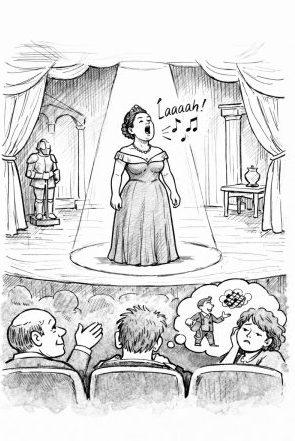
Can anyone learn how to sing? (can anyone learn how to become a better singer, and improve their singing technique?)
The answer is – yes, absolutely!! Most people would agree that vocal function is an automatic process. As babies, we’re able to make completely efficient sounds without any learning involved. And as every new parent knows, the baby’s cry is heard far and wide, and the baby never tires!
Singing starts with phonation – ‘the production or utterance of speech sounds’. In many ways speaking is simplified singing, or rather, singing is a heightened form of speaking, and most of us can speak without much thinking, and without it causing us any trouble. All vocalization–speech or song–requires air flow. Air flow is the root of it all. The sound waves are formed and travel on the air. When we speak or sing the air passes through the vocal folds, two small parallel muscles in the larynx, causing them to vibrate thus creating a sound. In singing we add a third component to the previous two ( air flow and vocal folds) – resonance.
If we argue that singing is a form of heightened speaking ( just like dancing could be likened to heightened everyday body movements), the singing form of phonation is less “natural” than speaking, and therefore may require special training. And what we train are specific muscles, and their interaction, just like a dancer! The big difference is we cannot see the muscles at work during singing. However, if we have a clear understanding of how each muscular action contributes to the whole, we can devise exercises that focus on specific actions.
A modern approach to training
That’s where it can become difficult to teach, and to overcome that, teachers have for decades relied on conveying sensations and visualizations to their students to achieve a desired sound. This is still a crucial part of the teaching process. However things have changed a lot over the last decades in terms of our knowledge of how the vocal cords and resonance function, and this gives the informed teacher a much better understanding of how to correct vocal imbalances, with the result that my students are rewarded with more focused and rapid improvement in their singing technique.